






Christoph Voll: The German sculptor who fell in love with a Danish artist—and with Blåvand
How is it that a German artist is buried here in Oksby? It’s a long story, but certainly not a boring one—because the memorial at Oksby Cemetery tells the story of Christoph Voll, a German sculptor who married a Danish artist and challenged authority.
Christoph Voll grew up in a Catholic monastery orphanage in Munich after his father’s death, where he was subjected to physical and verbal abuse by both monks and nuns until his mother took him to Dresden.
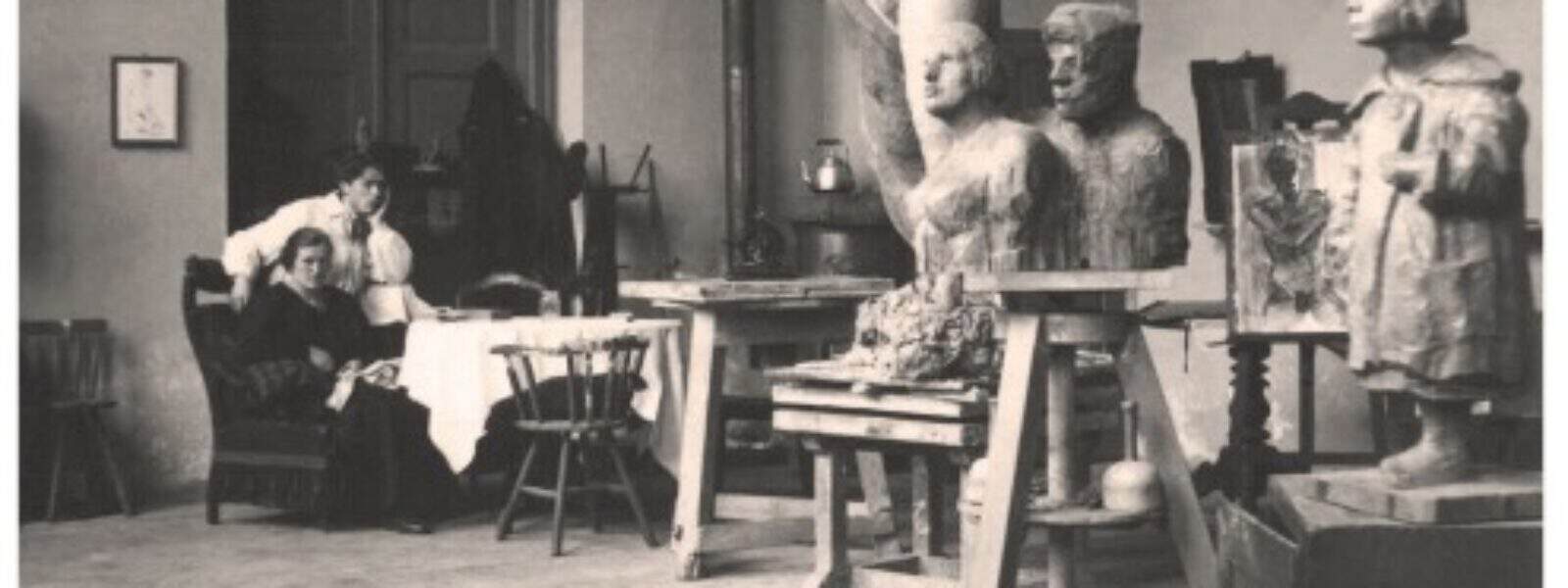
It was here that he began his career as an artist, studying under a renowned sculptor. But his apprenticeship came to an abrupt end when World War I broke out, and Voll was sent to the trenches in Flanders, the Somme, and on the Eastern Front. He had, however, learned enough during that time that, after the war, he was accepted into the renowned artists’ group Dresdner Sezession.
The encounter with Erna
Voll’s art revolved around his experiences at the orphanage and the social hardship that steadily increased during the war. While he was studying, Christoph Voll met the Danish artist Erna Sørensen, who was apprenticing with the painter Otto Kokoschka.
Christoph Voll and Erna Sørensen fell in love, married in 1922, and soon after had a daughter, Karen, after which Sørensen gave up her artistic career. The couple spent a large part of their vacations in Blåvand, which, with its sea, dunes, and women bathing, became a recurring theme in Voll’s art.
Vandalized by the Nazis
Voll was, all in all, a renowned artist, and during his lifetime he exhibited throughout most of Europe. His solo exhibition in Berlin in 1927 and a professorship at the sculpture academy in Saarbrücken really propelled his career—until the Nazis seized power in 1933.
Voll was not in the inner circle here, and he was even threatened with both dismissal and a concentration camp, but he managed to avoid punishment because his works focused on the workers. He was also commissioned by the regime until he rejected one of the offers; he was then fired as a professor and included in the “Entartete Kunst” exhibition.
He was subsequently banned from exhibiting and from leaving the country, and his works were vandalized by the Nazis.
Death and Legacy
Voll died of illness in 1939, but during his final years, a number of his works were rescued from Germany—thanks in part to Vilhelm Lundstrøm and Edvard Munch—in connection with a major Voll exhibition in Oslo. This exhibition never took place, but the works had already been packed and shipped in a freight car bound for Denmark, which was not yet occupied. When the train car arrived in Copenhagen, the works were brought to safety in the basements of Christiansborg Palace and at Erna’s family home on Funen. It is said that there was never an exhibition in Oslo, but that this was a way to get the works out of Germany and into Denmark.
After Voll’s death, Erna Voll smuggled herself, her daughter Karen, and Christoph’s ashes out of Germany under the pretext of visiting her Danish family, after which she buried her husband in the cemetery in Oksby, near the beach in Blåvand, where the couple had shared so many happy memories together.
Erna’s last wish was to be reunited with her husband, which happened in 1963. In 1948, Voll’s works were exhibited at Charlottenborg, after which some of them were sent to Karlsruhe, where Voll had lived and worked for many years.
By Museum Curator Josephine Nielsen-Bergqvist, based on the article “His Life Was Full of Stones” by Jesper Vind, M.A., in *Opdatering 2021*/*Weekendavisen*.