







Background knowledge on the Copenhagen plantations
The phenomenon of “Copenhagen plantations” emerged in the late 1800s as part of the afforestation project launched, with the Danish Heath Society at the forefront, to cultivate the Jutland heath. When the Danish Heath Society was founded in 1866, a number of wealthy Copenhageners chose to provide it with financial support. These affluent Copenhageners bought up exhausted land, fully aware that they would never make money from the areas. The land was subsequently cultivated and planted. The aim was to make better use of the land, provide work for the local population, and supply timber for the country.
In 1877, the founder of the Danish Heath Society, Enrico Dalgas, bought a dilapidated heath farm near Vorbasse, which he named Høllund Søgaard. At Høllund Søgaard, a plant nursery was established, which became an important part of the afforestation of the area, as it supplied many of the surrounding plantations with plants. Just as the land at Høllund Søgaard itself was planted. Høllund Søgaard then became the starting point for afforestation in the area. Here, Copenhageners were introduced to the heath cause and shown the possibilities on the heath. In this way, Høllund Søgaard and the plantations around it are important elements in understanding the cultivation of the heath and the afforestation.
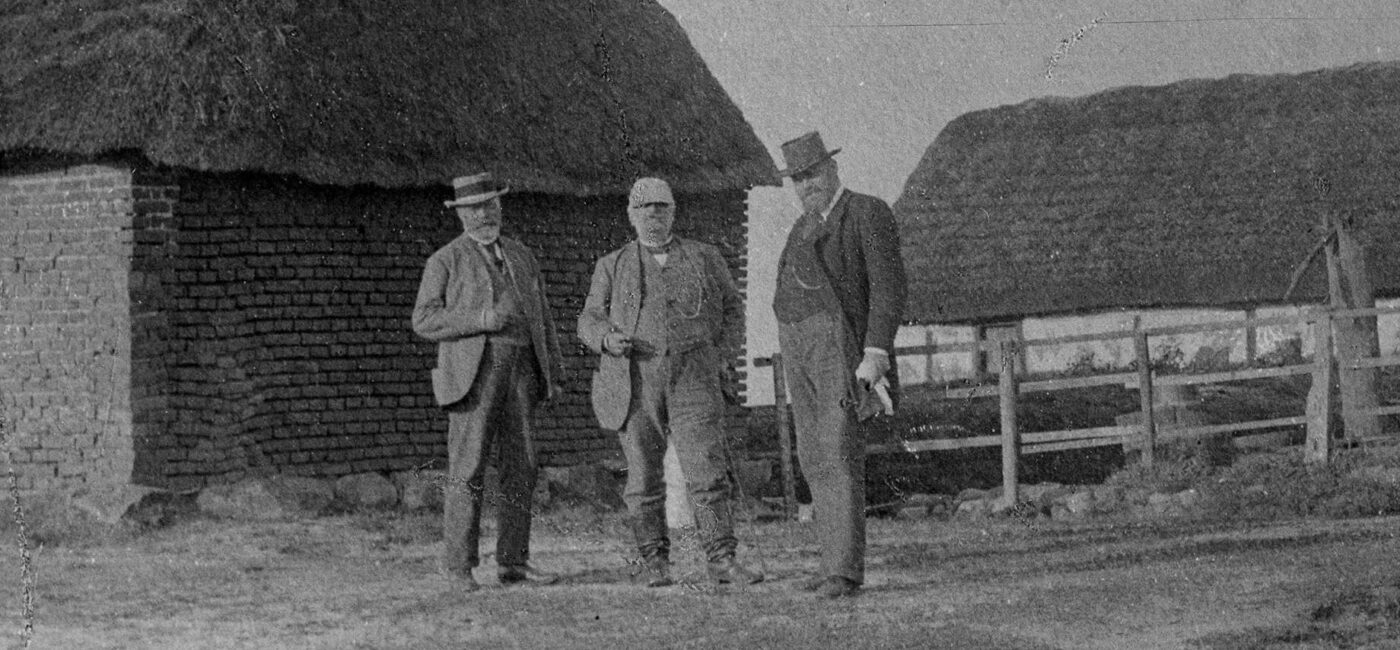
At the urging of, among others, Dalgas, the wealthy manufacturer and wholesaler Holger Petersen bought a heath farm in 1891 and established Baldersbæk Plantation. Once the heath cause had caught Holger Petersen’s interest, he saw it as a personal mission to lead the way in this work. He built up a model plantation and, at the same time, experimented with various crops such as hemp, cotton and different tree species. He worked intensively to recruit new members for the Danish Heath Society and sought to persuade his acquaintances to establish Jutland plantations. As part of these efforts, in 1892 he went on a tour of the Jutland heath together with other wealthy Copenhageners. This trip resulted in wholesaler Salomonsen buying Slauggaard Plantation, wholesaler Moresco buying Fromsseier Plantation, while architect Ingemann acquired Lundgaard Plantation. In addition, he managed to get wholesaler Skjold Børgesen to buy Utoft Plantation, bank director Axel Heide to buy Siam Plantation, which Holger Petersen’s cousin Andreas Petersen later bought and renamed Gyttegård Plantation, just as director Lauridsen established Dalagergaard Plantation and manufacturer Guildal established Guildal’s Plantation.
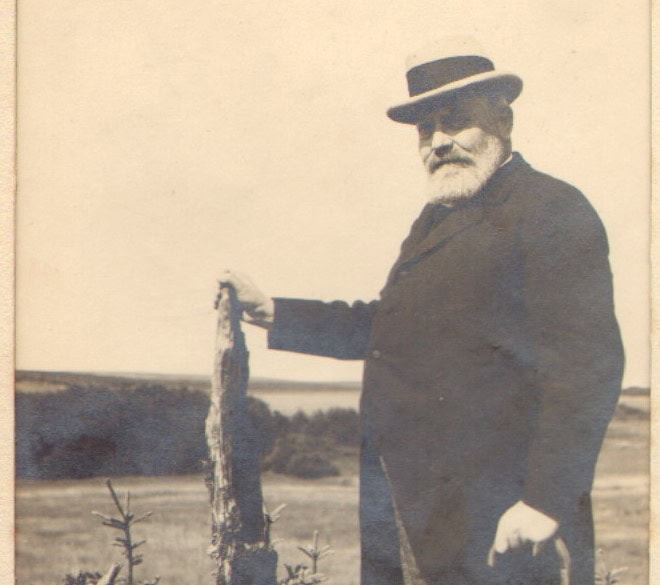
In Holger Petersen’s efforts to persuade wealthy Copenhageners to invest in heath plantations, he often used Baldersbæk as a PR initiative and was happy to show visitors around the well-run plantation. In the summer of 1913, for example, he invited the Committee of the Copenhagen Wholesale Merchants’ Society to Baldersbæk, where he happily and proudly showed off the plantation. In 1894, Dalgas died, and Høllund Søgaard was taken over by Holger Petersen jointly with Dalgas’ son, forest officer Christian Dalgas.
The buildings and building traditions
In the first many years, it was normal for plantation owners to fit out the forester’s house with a couple of rooms that the owners could use during their stays on the plantations. On most plantations, the existing farms were converted into foresters’ houses. An exception, however, is the forester’s house at Gyttegaard, where Heide had a new main house built with Hack Kampmann as architect, but still with accommodation for the forester at one end and a couple of rooms for the owners’ use at the other.
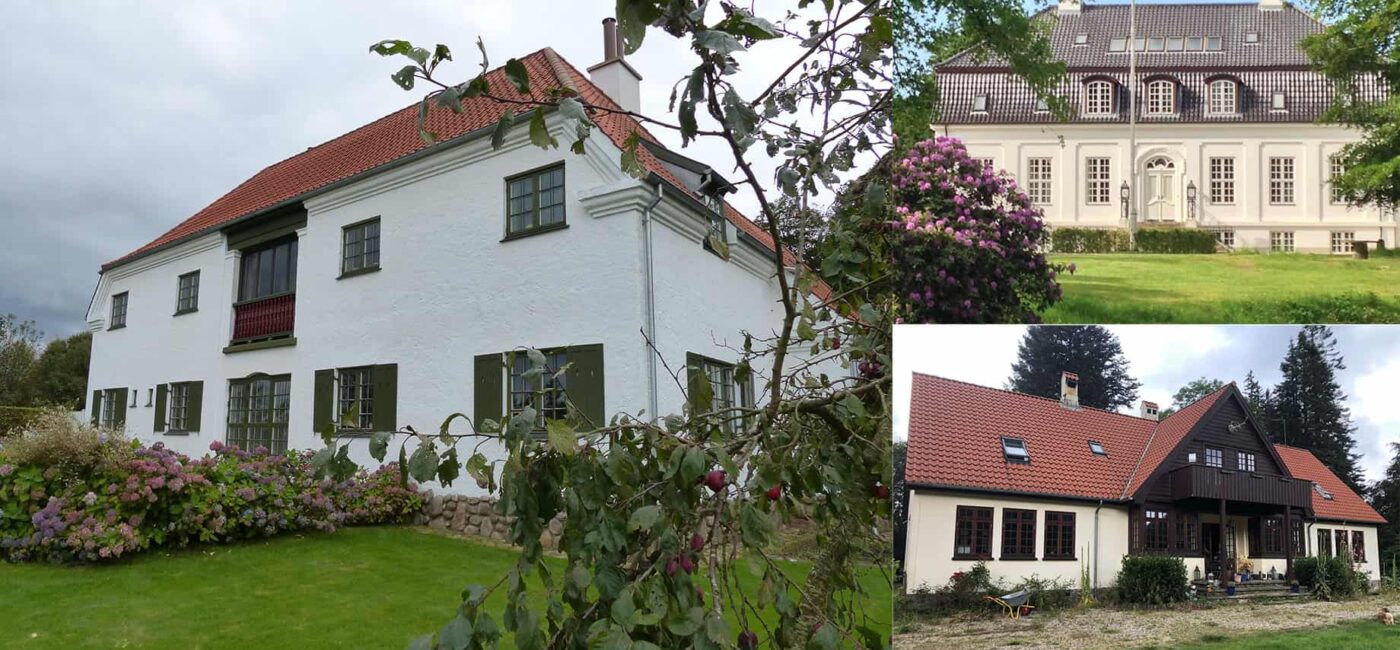
In 1905, the Moresco family, as the first Copenhageners, had a separate building built as a guest house for the family when they stayed at the plantation. Moresco hired the Copenhagen architects Bernhard and Valdemar Ingemann to produce the drawings for the new guest house. Compared with the Copenhageners’ homes around Copenhagen, it was a very primitive and unpretentious cabin. The inspiration may have come from the many span houses that characterised the heath at the time, as the building was constructed with very low sides and the rafters almost down to the ground. Roofing felt was used for the roof covering, while the wall surfaces in several places were clad with split spruce poles. In both gables, slightly narrower veranda-like extensions were added with large window sections. In the following years, all the homes at Fromsseier were rebuilt and improved, so that they came to appear whitewashed yellow with green-painted windows and doors, as well as thatched roofs.
In 1909, the architects Bernhard and Valdemar Ingemann built the large, pompous Villa Baldersbæk for the client Holger Petersen, and finally in 1911 they were commissioned to design the main building at Slauggard. In 1916, the two rooms at Gyttegaard’s forester’s house had become too small, so the owner Andreas Petersen had Royal Building Inspector Martin Borch build a large villa. At Gyttegaard as well as at Høllund Søgaard, Fromsseier and Slauggaard, these were buildings that broke strongly with the traditional Central Jutland building style. Instead, the plantations’ buildings were constructed in historical styles, often inspired by National Romanticism and with rich use of decorative elements and details. At Baldersbæk, on the other hand, the building was strongly inspired by the French architect Jean-Francois Blondel’s work ”De la des maisons de plaisance,” in which he describes living in the countryside.
It should be noted, however, that a large number of Copenhagen plantations such as Utoft, Dalagergaard, Frodeslund and Guildal’s Plantation never got large and distinctive main buildings.
Gardens and cultural environments
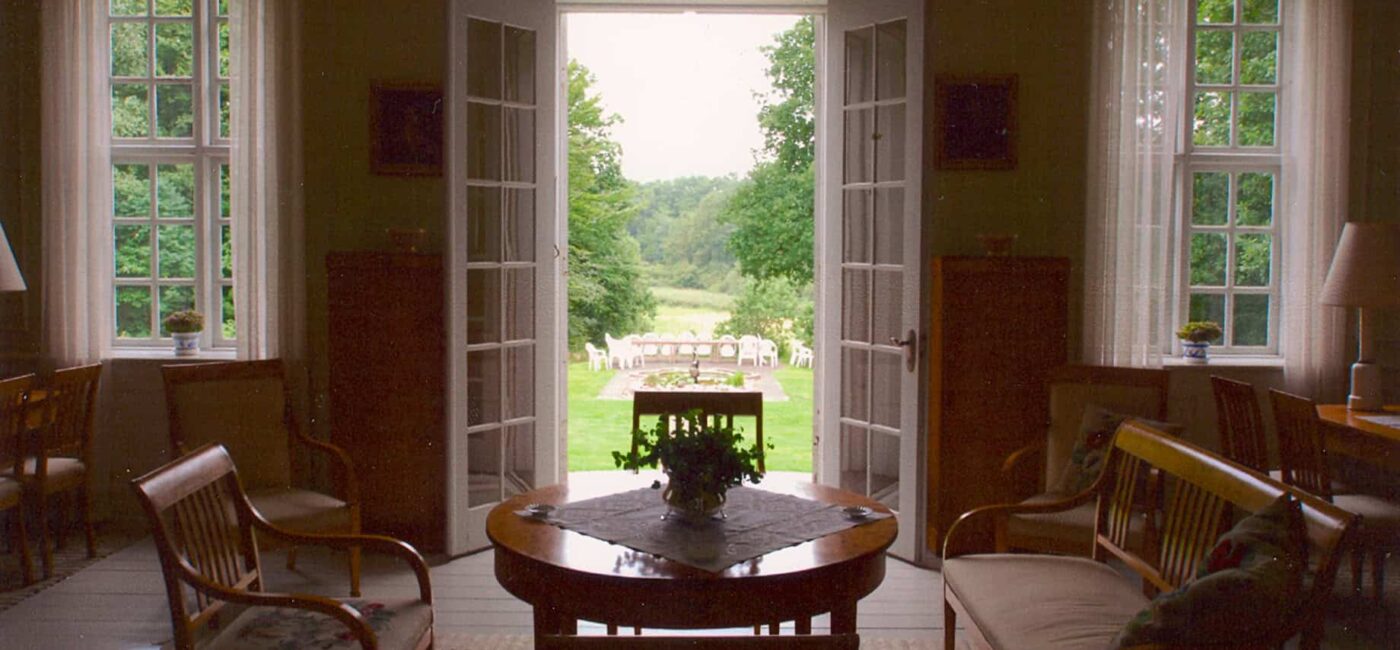
Several of the plantations created beautiful garden landscapes. At Høllund Søgaard, landscape architect Edvard Glæsel was commissioned to design the garden, and at Baldersbæk it was Copenhagen’s city gardener Erik Erstad Jørgensen who designed the garden. Fine garden landscapes were also created at Slauggard and Gyttegaard with carp ponds, flowerbeds and gravel paths. Although no distinctive main building was ever built at Utoft, the owners still chose to create a large and romantic garden landscape around the farm. At both Høllund Søgaard and Baldersbæk, a number of festive features were established in the plantation in the form of statues, fountains, pergolas, etc.
Memorials to the afforestation and the founders were also erected around the plantations. For the design of these statues and fountains, it was often the sculptor Anders Bundgaard who was used. Thus, in the period 1913–1918 he was behind the stone dolmen, the district stone, the statue and the fountains at Baldersbæk. At Høllund Søgaard, in 1916 he created the statue of Enrico Dalgas, and the following year he created the memorial stone in Utoft Plantation for the site’s founder Skjold Børgesen.
The major investments in both buildings and garden landscapes, etc., were often made by the second-generation owners and testify to increased use of the properties – especially in connection with holidays.
Nature
In connection with the purchase of Utoft, Dalgas describes the importance of the Copenhagen wholesaler also getting Hejnsvig Bakkeknude included in the purchase, and he ends the letter by stating…Such people will gladly sacrifice something on the altar of the fatherland, but they would also like a reasonably attractive area. How much significance nature and the view have had in the establishment of the plantations is difficult to assess, but the vast majority of the properties were built with views over heaths, bogs, meadows and other beautiful natural areas.
Grene Sande
In general, most of the plantations contain different types of nature that in many ways break up the monotonous conifer culture that otherwise characterises the plantations. Thus, several of the plantations still have large preserved heath areas – for example at Gyttegaard, where most of it has been designated a Natura 2000 area due to its special flora and fauna. Particularly special in this context is Grene Sande. During the last Ice Age, the Weichsel Ice Age, the south-western part of Jutland was not covered. The great ice masses had their standstill line at Randbøl, and from here the meltwater flowed westwards and formed the Grindsted outwash plain. On the south side of Grene Sande, it is easy to sense how the great rivers formed by the meltwater have cut into the landscape and created the steep erosion escarpment that is over 10 metres high. Once the ice was gone, the area lay as a great sand desert without vegetation. Strong westerly winds blew large masses of sand inland, which, among other things, were trapped by a moist base at Grene Sande, thereby forming the sand dunes. In the 1600s–1700s, the average temperature became somewhat lower, which meant that the westerly wind could blow large amounts of sand from the West Coast beaches in over the Jutland heath. At Grene Sande, the already existing sand dunes stopped the drifting sand, and a large parabolic dune was slowly formed.
Baldersbæk
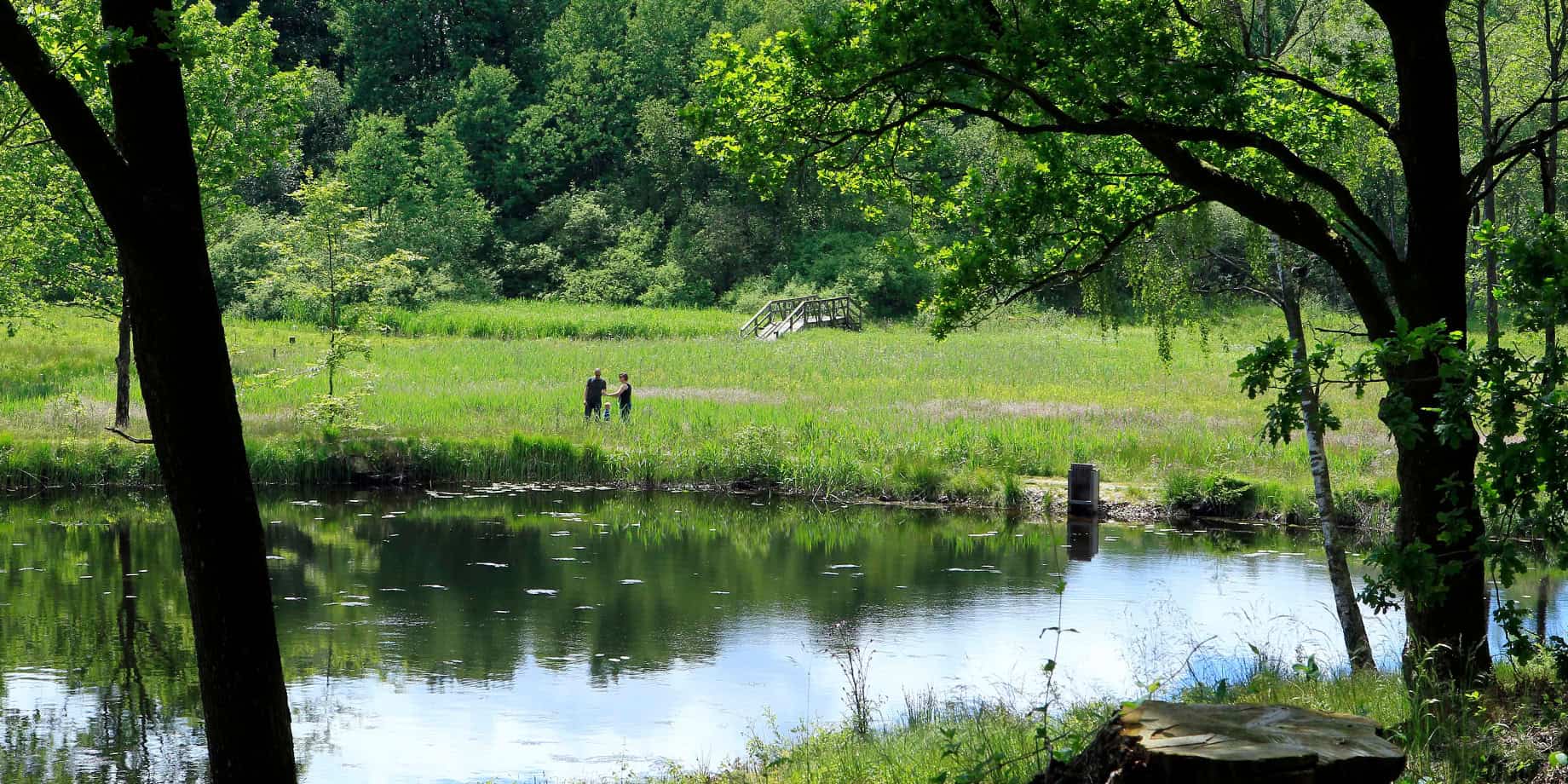
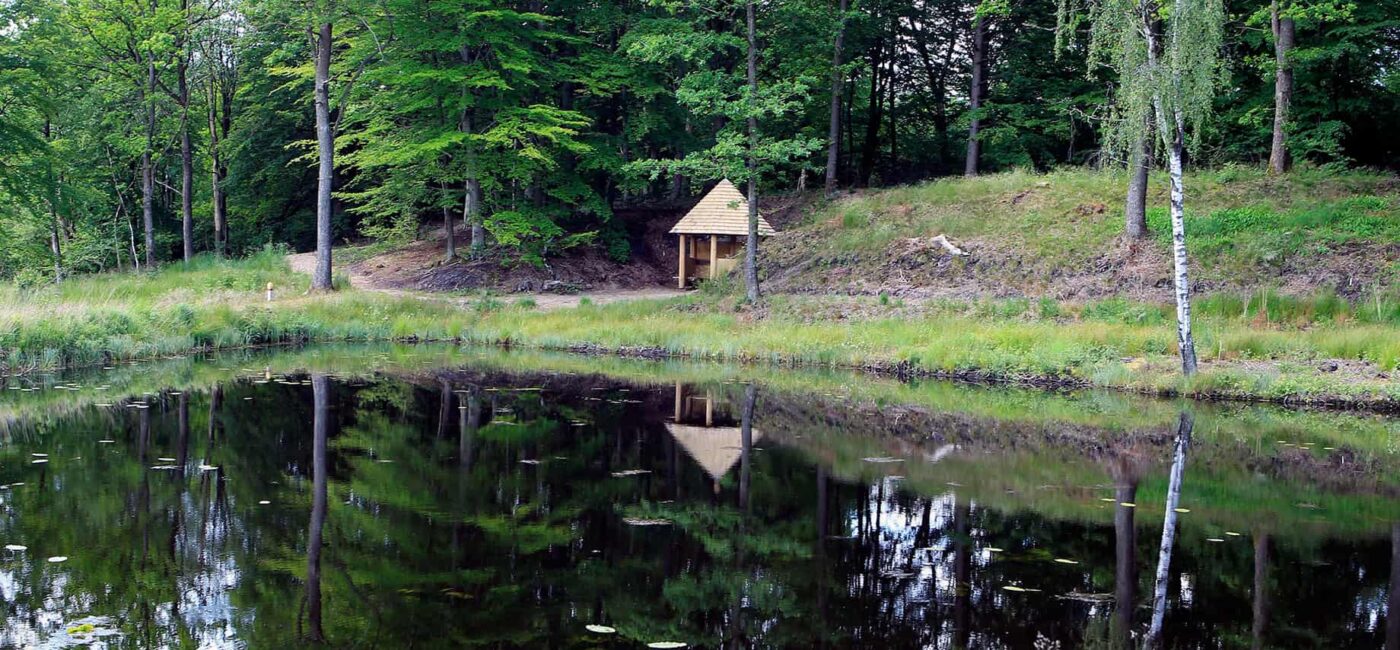
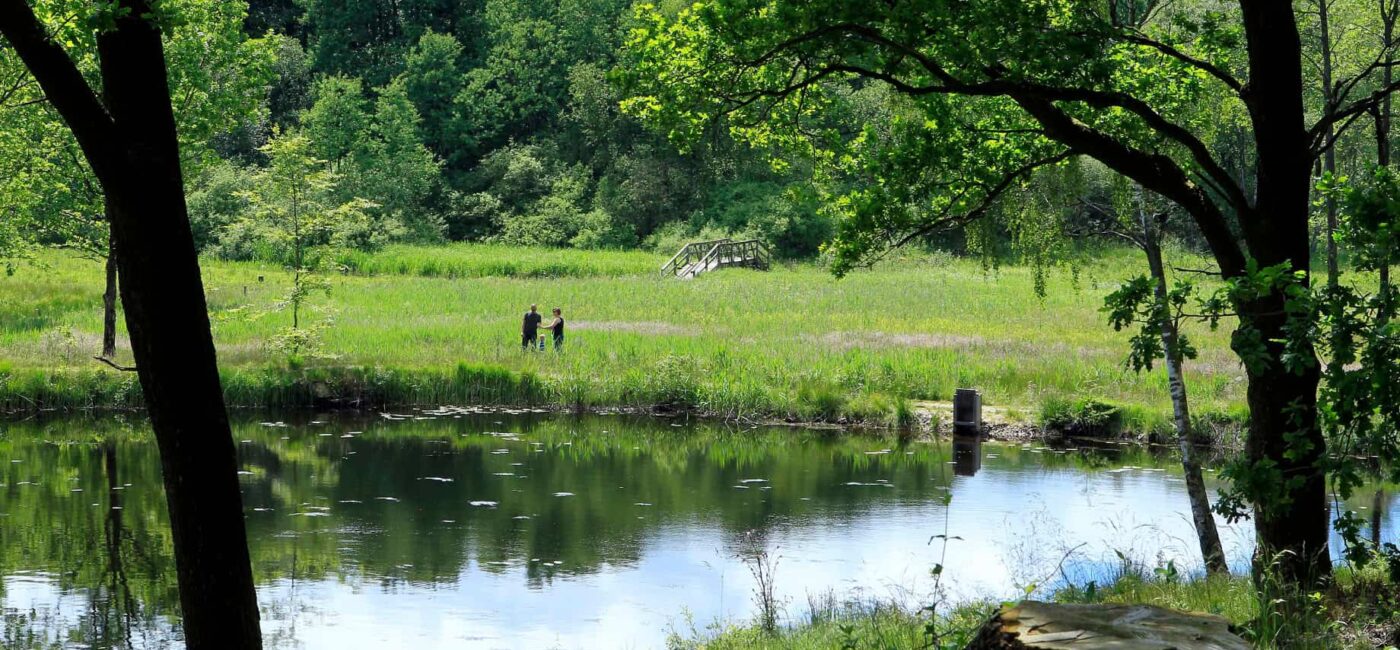
Also very special are the meadows along the stream Baldersbæk, which has its source spring and runs through the meadow valley down to the four artificially created ponds. The ponds were originally the result of peat cutting, but in 1913 Holger Petersen and sculptor Anders Bundgaard regulated the ponds and dammed up the lakes. The lakes, which are very nutrient-poor, clean lakes, were created as carp ponds – that is, very shallow lakes with a deep channel in the middle. Along the stream there is a very nutrient-poor peat bog, which forms a very special flora and fauna.
The significance of the Copenhagen plantations
Today, about 100 years after these plantations were established on the flat heath, the plantations still exist with their natural and cultural values, to the benefit of the population. Like small, unique oases, they lie here in the West Jutland landscape, enriching the scenery and bearing witness to the struggle to plant the heath.
The story of the Copenhagen plantations is also a story of Copenhageners and farmers from West Jutland with very different economic and cultural backgrounds, and of these people’s lives close to one another in the small mini-society that the Copenhagen plantations came to constitute. With their own hierarchy, their own written and unwritten laws, and their own distinctive style. A world you were either part of or not part of.
In this way, the many large plantations over time gained great social and economic significance for the area. On the one hand, they brought life, initiative and money to the heath areas, and on the other, many less well-off heath farmers raised working capital through plantation work – a help in expanding their own farming. It should also be added that many plantation owners were extremely active in improving the farmers’ agriculture. Thus, they introduced the use of artificial fertiliser to the farmers and even financed the farmers’ use of it at the beginning. The villas also needed labour – for cooking, polishing kerosene lamps, making beds, fetching water for the washbasins, cleaning and serving the many guests.
The villas in the Copenhagen plantations were all established as holiday homes for Copenhagen’s bourgeoisie. In this way, the Copenhageners introduced a completely new concept to the heath farmers: “free time”. A split between working life and leisure time had never been something the West Jutland farmers had practised. For many of them, it was shocking to see the luxury and idleness that played out on the plantation estates.
Suddenly, the local population became familiar with landscape architects and concepts such as parterre gardens, gazebos, building styles, cars, motorcycles, etc. It also caused quite a bit of amazement when the beautiful carriages of the gentry suddenly came driving across the heath. In the forest too, the many amusing ideas the Copenhageners had brought life and activity to the previously desolate heath.
The Danish Heath Society’s former director, C.E. Flensborg, writes at the beginning of the 1900s that the large plantations almost functioned as a kind of cultural centres in the previously so desolate heath areas. Although the large country houses were built as holiday homes, emphasis was placed on being able to live in a manner befitting one’s status while ”staying” in the countryside. The houses, the garden, one’s clothing and one’s habits were arranged in full accordance with the bourgeoisie’s own understanding of what was appropriate for their social class. In this way, the gentry brought all their cultural baggage with them from the capital. Every year, a large number of the country’s best artists were invited on holiday to the villas. Many of these artists carried out various jobs for the plantation owners. This means that many of the plantations were equipped with art of very high quality.
Already in the 1960s, the pressure from tourists in the plantations began to increase. Now it was not only to see the large, foreign-looking villas and hunting lodges, but also to enjoy nature in the changed surroundings. The development of holidays and leisure time meant that parking areas were created at several plantations. More people applied for permission to build summer houses by the plantations, which had the effect that many plantations had large parts of their areas protected as nature reserves to prevent further development. Unfortunately, the plantations’ buildings, with the exception of the main building at Gyttegaard, are neither listed nor protected by preservation local plans. This means that the built cultural heritage found in the plantations is slowly disappearing.