





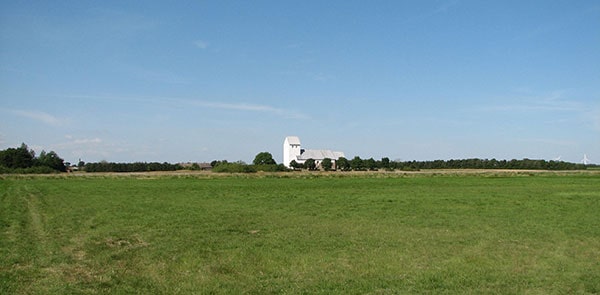
Janderup landing place
On large green meadowlands by a natural bend in the Varde River, you will find the Janderup landing place.
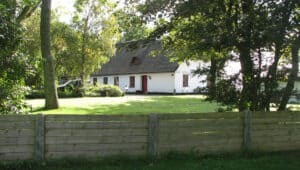
Janderup Church and churchyard lie out in the open on the meadow by the north side of the river’s bend, and to the west the landing place lies like a naturally formed harbour. Here, most ships had to transfer their cargo to barges to get the goods all the way up to Varde. Between the church and the landing place is Skipperhuset, the former inn, which for a long period also served as the ferry house.
Today, the landing place has been set up as a recreational area and campsite, supplemented with wooden jetties for mooring boats. A storm-surge column on the site is a reminder that the river’s water level is affected by the tides in the Wadden Sea, and regularly overflows its banks.
The oldest Janderup
The location of Janderup Church close to the river and the landing place bears witness to the old Janderup – before the dairy and the railway arrived. The village lay as a row of houses following the river’s meanders and the lush meadows to the west. The area has been inhabited far back in time. The location was ideal due to the naturally formed harbour site and access to the river.
Janderup is first mentioned in written sources in 1295 under the name ‘Jamthorp’. The town is much older, however; there has been settlement here at least since the Iron Age. Near the church, traces have been observed of two rows of longhouses and more than 20 pits or pit-houses, suggesting that a village once lay at Killemåde. No archaeological excavations have been carried out at the site, so there is no precise dating of the houses. It was entirely normal for Iron Age villages to move around the landscape within a local area.
Click here to watch a short film about the Janderup landing place
Janderup Church
Janderup Church is one of West Jutland’s most richly decorated village churches. Rising water levels and storm surges have on several occasions meant that the water has reached right up to the church. The church lies in the Varde River valley a little south of the present-day town of Janderup. Its location by the river made it easier to transport building materials to the church, but also led to repeated flooding of the churchyard, where stones have toppled and graves have sunk.
The church’s location in the river valley has influenced the church building in several ways. The water level in the Varde River changes constantly. Up to a point east of Janderup, the water level is affected by the daily tidal rhythm in Ho Bay, and the river valley is vulnerable during storm surges. Several times the water has overflowed its banks and flooded the area.
In connection with the construction of the church, the location made it easy to transport building materials by ship. However, the position close to the water’s edge could also make transporting materials more difficult. During the storm in 1981, the water rose right up around the church, so when organ builders were to carry the newly renovated organ into the church, they had to wade through the water in rubber boots to get the organ parts indoors.
In Janderup, people talk about “the floating gravestones”. During the storm surge on the night of 3 December 1909, the water rose over the churchyard and caused great damage. Half the graves sank and left deep holes, while gravestones and monuments toppled. Several similar episodes are told of, where the stone-faced earth dyke surrounding the churchyard has not been able to keep the masses of water out.
Despite these conditions, the 800-year-old Romanesque church still stands tall and unyielding in the landscape, marking from many kilometres away the place that was once Varde’s most important shipping point.
Janderup landing place
The landing place at Janderup is first mentioned among Varde’s landing places in 1554. Goods carried on larger seagoing ships were transferred to barges and smaller boats out in Ho Bay. There was probably a landing place at Janderup before the church was built in the 13th century. As the last broad stretch of the river, still governed by the sea’s ebb and flow, it was a natural end point for the slightly larger ships bringing goods from Ho Bay. To continue on to Varde, the goods had to be hauled by hand on smaller barges while walking along the river – or rowed. Even so, it was still both faster and easier to transport goods via the river than to drive them by wagon along the poor roads.
The landing place and the Jutland pots
The landing place had a large hinterland. When farmers came, especially from Tistrup, Thorstrup, Horne and Hodde, with their production of Jutland pots, they had to plan their journey according to the rhythm of the tides. The ships had to be loaded at low tide, because then you could drive right out to them with the wagonload. When the tide came in again, the water level rose, and the flat-bottomed ships once more sailed the trip out to sea. Sometimes the farmers had to drive in the middle of the night. It was a long journey in the dark along the poor roads, and many pots did not survive the trip.
Customs post for Varde
In the 17th century, Janderup was the outer harbour for the market town of Varde, and several Janderup residents were farmers, skippers and merchants all at once. Despite the town’s inland location, there was a maritime atmosphere in the village environment. People came to Janderup to collect goods, and in return the ships were loaded with building materials from home. There were similar landing places at Ho and Hjerting.
In 1680, a customs post was established at Janderup harbour as a branch under the Varde customs post. It was illegal to export goods such as bacon and butter without paying duty, and the customs officer kept strict control. Traders made creative attempts to hide smuggled cargo behind, for example, a layer of Jutland pots, but were often discovered and fined.
When Hjerting took over the customs function from Varde, it indirectly meant that the Janderup customs post was closed, and that black pots could no longer be shipped from here. Despite this, Janderup landing place remained in use well into the 19th century.
The beginning of the end
In 1692, the Varde customs post was moved to Hjerting, but goods were still unloaded at the Janderup landing place. They then had to be cleared through customs in Hjerting. The landing place was used into the 19th century, even though a resolution from 1804 required payment to sail on the river. Until the beginning of the 20th century, heather and peat were shipped to Fanø from the Janderup landing place, and when the dairy in Janderup was built in 1883, the building materials were shipped in to the landing place. In 1903, the railway came to Janderup. The transport of goods that had previously taken place via the river now shifted to the railway. The landing place’s time as a trading and freight hub was over.
Skipperhuset
Skipperhuset was first mentioned as a “Privileged Inn” in 1787. However, the place was already mentioned in 1640 in connection with the market town of Varde being granted a right of first refusal to the house at the time. Skipperhuset was built to serve merchants and skippers who were waiting for the tide to turn.
After a quiet period in the 19th century, life returned around Skipperhuset when the dairy in Janderup was built in 1883 and the building materials were shipped on barges into the landing place. However, it was a short-lived boom. In 1913, the temperance association bought the inn’s liquor licence, and five years later the inn closed.
The present Skipperhus was built in 1812 by Frands Bennetsen (1764–1834), who had taken over the deed in 1797. The location was attractive in relation to the landing place – but not quite so attractive in relation to flooding. The house lies on a small sandbank by the Varde River, but has been flooded several times during storm surges.
Inn and ferry crossing
In 1818, Skipperhuset was granted a licence to operate a ferry service, where people could be taken by barge across the Varde River to and from the Alslev side. There was a ferry crossing with barge traffic across the river until 1910, when the county council no longer wanted to provide subsidies. If you wanted to be ferried across from the Alslev side, you were said to have to call out to the innkeeper at Skipperhuset about 100 metres before you reached the riverbank. If you got too close to the river, the current would carry the words out to sea.
For many Janderup residents, Skipperhuset is inseparably linked with Christian Sørensen Riber (1896–1976), popularly known as Kræ Riwer. He was a great storyteller, and his eel feasts were known far and wide. During his ownership from 1929 until his death, the buildings fell into disrepair.
The house has since been beautifully restored, and the old inn now serves as a private home. Skipperhuset can be seen from the road. Please respect the residents’ privacy.